


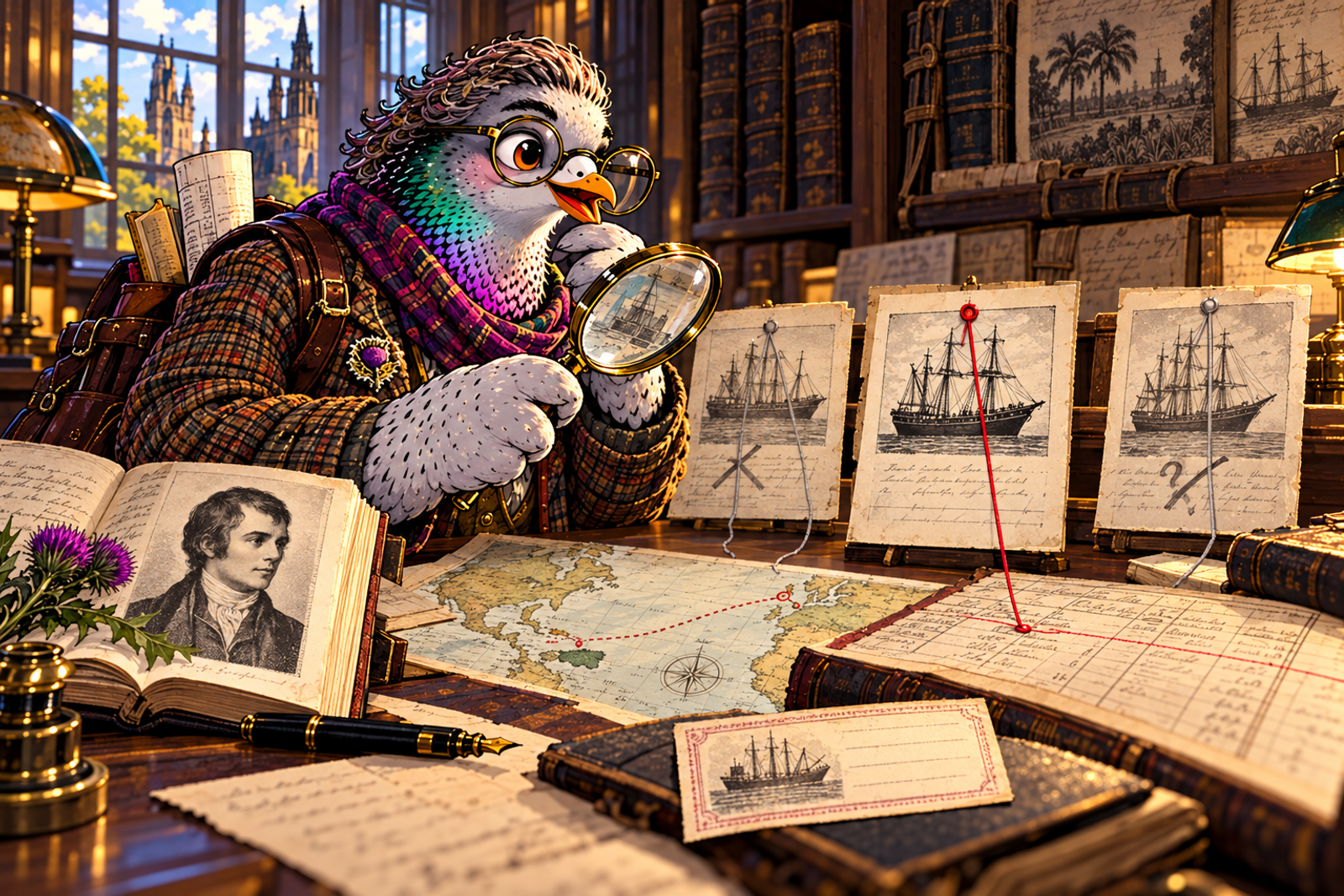
Robert Burns has spent two centuries booked onto three ships he never boarded. A new University of Glasgow study has now taken the passenger list out of the display case and reduced the itinerary to one confirmed passage. I have placed the legend and the ledger beside each other. The ledger is being less sociable.
Historians Stephen Mullen and Craig Lamont examined correspondence, shipping advertisements, plantation papers and other records for their article in the Burns Chronicle. They argue that the familiar Nancy, Bell and Roselle sequence does not survive documentary checking. Their evidence supports one booking, on the Bell, due to sail for Jamaica on 17 October 1786.
That correction does not turn Burns into an eighteenth-century innocent who merely wandered towards the wrong quay. He intended to take work as a bookkeeper on a Jamaican plantation, a role that would have involved supervising enslaved people. The new study says he bought a passage and lost the money when he did not sail. It also says he never reached Jamaica, never worked on a plantation and did not profit from the slave trade or chattel slavery.
The distinction is the argument. Mullen and Lamont separate a serious intention and an unused ticket from material participation in the system. They say Burns should no longer be used as an emblem for Scots who actually travelled, traded, owned plantations or enslaved people. This is not an eraser. It is the sort of pencil with a very sharp end.
Their account also revises the timing and motive. Burns was facing a failing farm and personal turmoil in 1786, while the success of Poems, Chiefly in the Scottish Dialect offered another future. The researchers calculate that the value of his publishing profits, compared with average earnings in 2024, was about £1.76 million. A Jamaican bookkeeper's starting salary of £30 would have needed almost 29 years to reach the same sum. Poetry, for once, won the spreadsheet.
This is not the only scholarly interpretation in the room. In 2017, Clark McGinn used newly identified documents to argue that Burns kept the Jamaica option open until a better offer appeared and that the decision was economic rather than a moral rejection of slavery. Public heritage writing has also described several attempted voyages and stressed Burns's silence on slavery, his praise for an enslaver and his connections to patrons whose wealth came from the Caribbean.
The new paper disputes parts of that itinerary and the weight placed on it. It does not dissolve Scotland's wider history into a puff of bardic mist. National Galleries of Scotland describes a country deeply shaped by slave-produced wealth, colonial trade, plantation ownership and compensation paid to enslavers. Removing an unsupported ship from Burns's biography leaves all of that history exactly where the records put it.
The responsible conclusion is therefore narrower than either acquittal or conviction by tartan association. One team has produced a peer-reviewed argument for a single confirmed booking and no direct material participation beyond the unused passage. Earlier scholarship supplies a tougher reading of intent and moral choice. Museums, schools and commemorations now have to name which claim they are making and show the evidence underneath it.
The Professor's verdict is that historical nuance is not a pardon and a footnote is not a hostile act. Burns could plan to enter a brutal system, fail to enter it, benefit from a different opportunity and later acquire a cleaner legend than the documents deserve. All four statements can sit on the same ledge. The archive has room, even when the commemorative tea towel does not.