

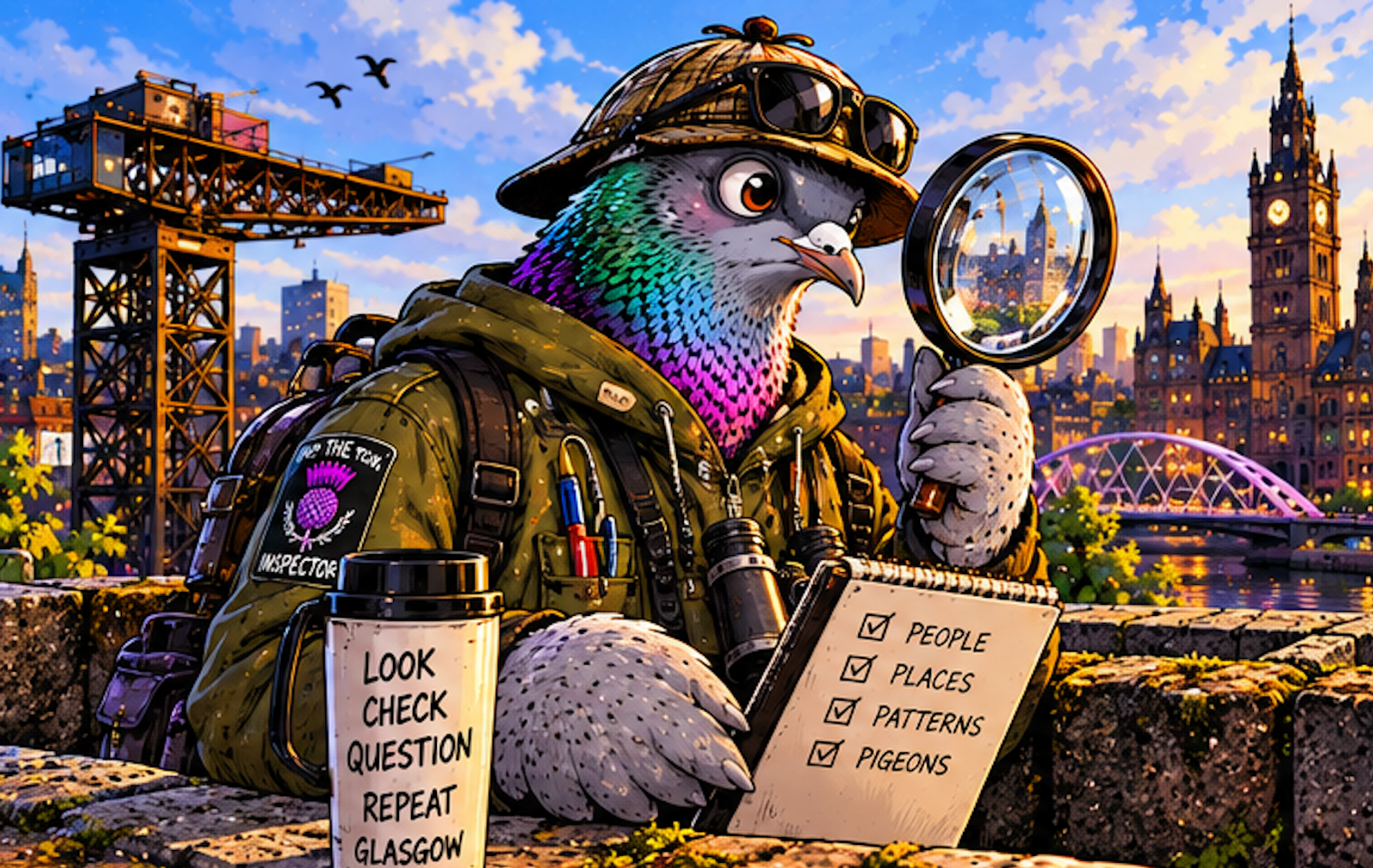

The Inspector has a problem with round numbers. They are where perfectly good facts go to get their corners knocked off.
Thomas Kerr MSP put one into the timeline this week: almost one million people in Scotland are living in poverty. He also described Scotland as a country of only five million people. The second number needs a red pen. The first, unfortunately, survives inspection.
The latest Poverty in Scotland report from the Joseph Rowntree Foundation puts the number at 940,000 people in relative poverty after housing costs, around 17% of the population. It also estimates that 11% are in deep poverty and 7% in very deep poverty.
At this point The Inspector would normally enjoy the correction. Population estimate: nearer 5.5 million. Margin note: see me after class. Tiny flourish of the ruler.
But that would be inspecting the label while the building behind it is on fire.
The more revealing measurement is child poverty, because Scotland did not merely say it would like to reduce it. It put targets into law. By 2030, relative child poverty is supposed to be below 10%. The current three-year figure is 21%.
The Inspector has checked that twice.
Twenty-one is not a rounding error away from ten. It is more than double it.
There is an important caution before anyone reaches for a graph and starts drawing dramatic arrows. The way the statistics are calculated has changed, with benefit records now being linked to survey data. That creates a break in the series and makes simple year-by-year comparisons less clean than they look. Single-year estimates also move around.
So the evidence does not support every shouty version of 'things are getting worse'. It supports something more awkward: Scotland is still a very long way from where it legally said it would be.
The independent Poverty and Inequality Commission has reached much the same conclusion. It says government action is helping families, but Scotland remains on course to miss the child poverty targets by a large margin.
And now comes the bit that ruins a perfectly tidy political argument.
The Scottish Government says its policies are making a measurable difference. Its Programme for Government says relative child poverty is six percentage points lower in Scotland than the UK average, and estimates that its package of measures will keep around 100,000 children out of relative poverty this year. The Scottish Child Payment alone is forecast to keep 50,000 children out.
The Inspector has no objection to giving credit where the numbers support it. A clipboard is not a party membership card.
So both things have to stay on the page. Scotland can be doing more than elsewhere. Its policies can be keeping children out of poverty. It can still be nowhere near its own statutory target.
That is not a contradiction. It is the measurement.
Responsibility is untidy too. Holyrood controls important parts of social security, housing, childcare and local government policy. Westminster controls other major parts of tax and benefits. Councils run services that can make poverty easier or harder to survive. The Joseph Rowntree Foundation argues that all three levels matter, with particular concern about the capacity and funding of local government.
Everyone therefore has somewhere useful to point.
The Inspector prefers the figures.
Nearly half of children in minority ethnic families are in poverty. Families with a baby and larger families face particularly high rates. More than nine in ten children in poverty are in at least one of the Scottish Government’s own priority family groups.
Those are not abstract percentages once you stop looking at them from a lectern. They are heating, food, shoes, school trips, bus fares and the quiet arithmetic families do at kitchen tables.
So yes, Thomas Kerr’s population maths can take a gentle peck. Scotland has nearer 5.5 million people than five million. The correction is fair.
It is also the least important number in the story.
In a country that describes eradicating child poverty as a defining mission, progress ought to be visible without a magnifying glass. By 2030, fewer than one child in ten is supposed to be living in relative poverty. Today it is roughly one in five.
From the ledge, The Inspector can see humans throwing away enough chips to feed half a flock. He can also see other humans counting coins before they go into the shop.
Pigeons are supposed to search discarded paper for scraps.
Children are not.
Inspection complete.