

The University of Glasgow is hosting 1,984 copies of the same novel and arranging them as art. The Professor considers this excellent collection management. One book for every possible opinion, provided every opinion has first been cleared by the Ministry of Truth.
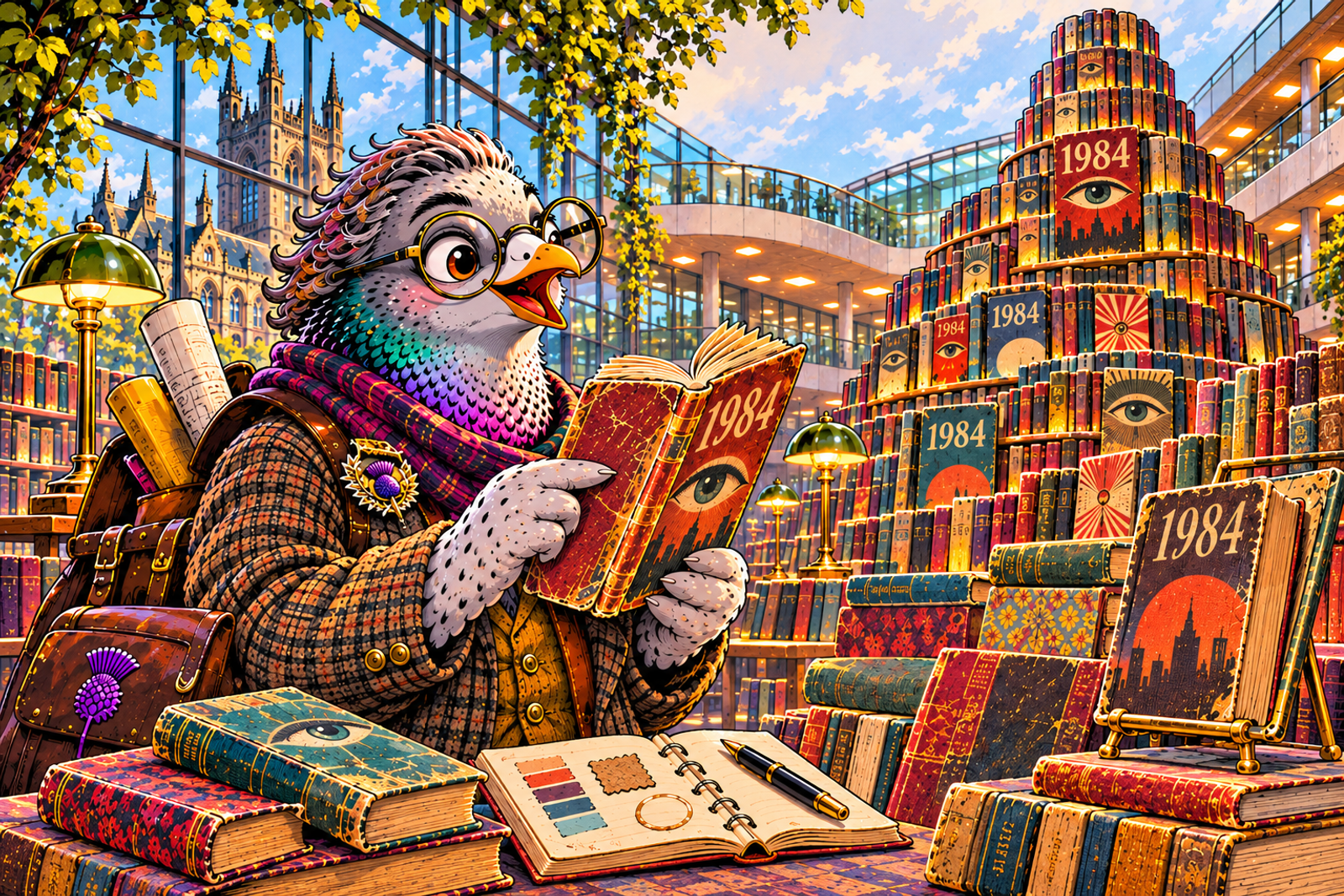
Hans K Clausen’s Winston Smith Library of Victory and Truth is now open in the Advanced Research Centre on Chapel Lane. The free installation runs until Friday 20 November and consists entirely of copies of George Orwell’s Nineteen Eighty-Four, donated and sourced from around the world.
This is not simply a very committed second-hand book stall. The work has travelled as a library, sculpture, museum, curiosity and meeting place. Its title borrows Orwell’s doomed clerk Winston Smith and then gives him the sort of institutional branding package that would make a university communications office sit up straighter.
The pleasure is in the sameness refusing to stay the same. POLART, the University research project hosting the work, describes editions carrying coffee marks, drawings, notes, receipts, pressed flowers and the yellowing of much-loved paper. The words recur, but the objects have travelled through different languages, owners and lives. A warning about enforced uniformity has become a monument to unruly marginalia.
The University lists the exhibition as free and open from 8am to 7.15pm. POLART’s detailed programme gives the more conservative weekday window of 9am to 5pm. The Professor recommends the latter if you prefer your dystopia with an unlocked front door and somebody available to point at the books.
A free ticketed launch is listed for Thursday 5 November from 5.30pm to 7pm, with Clausen introducing the work, plus drinks and canapés. The Eventbrite page was live when checked. The academic symposium on 5 and 6 November is invitation-only, but the exhibition itself is public and free, an administrative distinction Orwell might have enjoyed filing under Access.
POLART is interested in how art can shape public knowledge and policy. The installation gets there by a more tactile route than another panel discussion. It asks what happens when a supposedly identical text arrives in 1,984 different physical histories, each one creased, annotated, translated and stubbornly held.
Glasgow already knows that buildings and books accumulate arguments. Here the argument has been stacked into a spectacular room and left open for visitors. You can go for Orwell, for book design, for the oddity of the number or simply to admire the logistical confidence required to move nearly two thousand warnings about bureaucracy through a university bureaucracy.