


The Professor has always maintained that when humans encounter something sufficiently complicated, they eventually do one of three things: write an equation about it, argue about it for a century, or ask an artist to have a go.
Glasgow is currently doing all three.
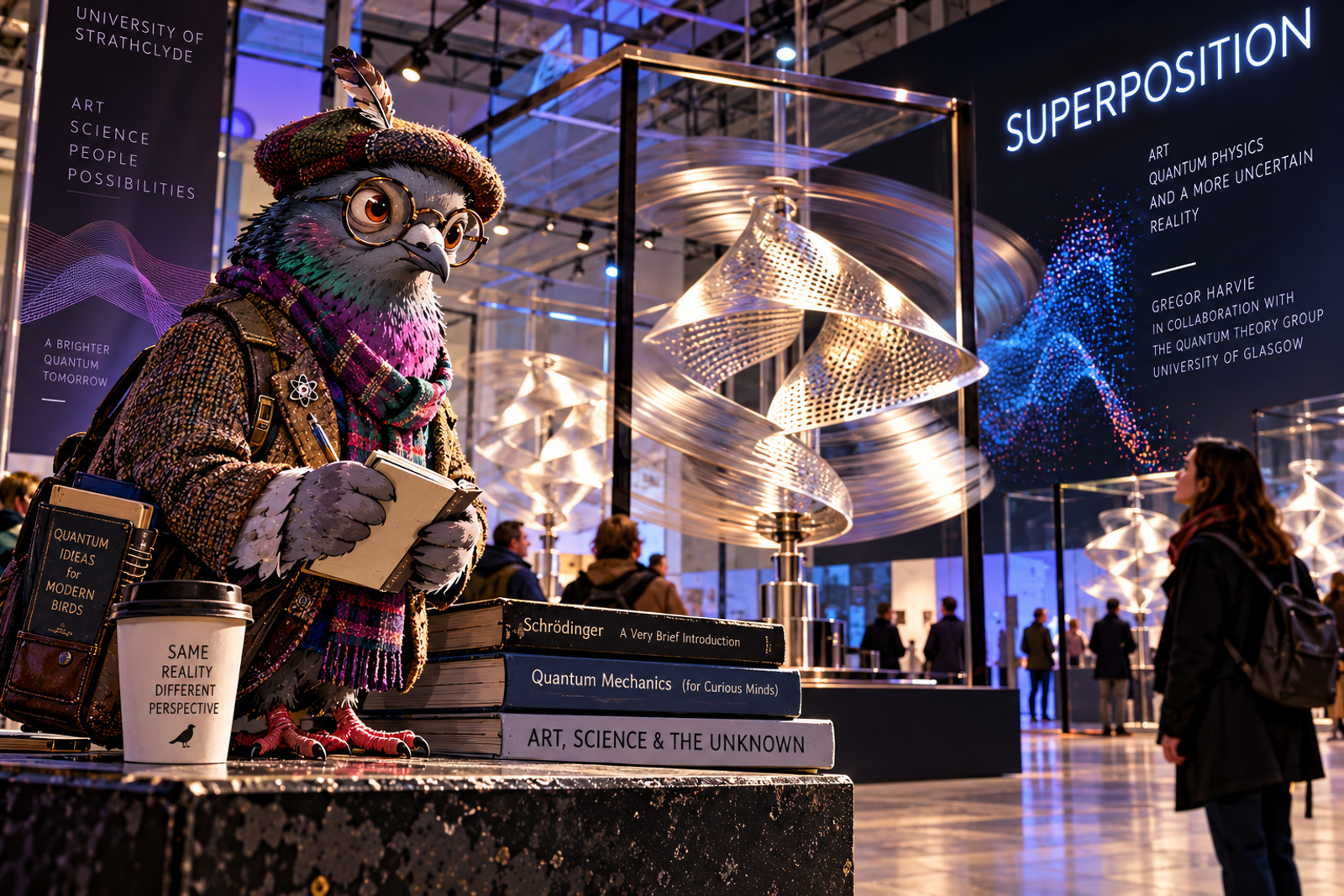
Later this month, Scottish artist Gregor Harvie is bringing Superposition to the University of Strathclyde. Created with the Quantum Theory Group at the University of Glasgow, it uses sixteen spinning aluminium artworks to turn one of physics’ least intuitive ideas into something you can actually stand in front of.
The pieces spin at 400 revolutions per minute, appearing to form shapes that are not really there, before stopping and becoming ordinary sheets of metal again.
That would already be enough to get The Professor out of the library.
But each artwork also has an identical twin, and one pair behaves rather oddly. Instead of settling randomly, the two pieces land on the same side around three quarters of the time.
Which is where a kinetic sculpture starts looking suspiciously like a physics problem wearing gallery lighting.
The installation marks the centenary of the Schrödinger equation, one of the foundations of quantum mechanics. The Professor considers this an excellent way to celebrate a hundredth birthday: no cake, just sixteen metal objects quietly asking whether certainty was ever a sensible expectation.
There is also something rather Glaswegian about it.
The city is already deep into quantum research, from computing and sensing to communications and the awkward business of deciding what any of it will actually mean once it escapes the laboratory.
And that is where the art becomes useful.
Scientists can tell us how something works. Artists are often better at asking what it feels like when it does.
You do not need to understand wavefunctions or Hilbert spaces to look at Superposition. You can simply watch something appear, disappear and leave you slightly less certain than you were a minute ago.
The Professor has built an entire career around that sensation.
It is called learning.