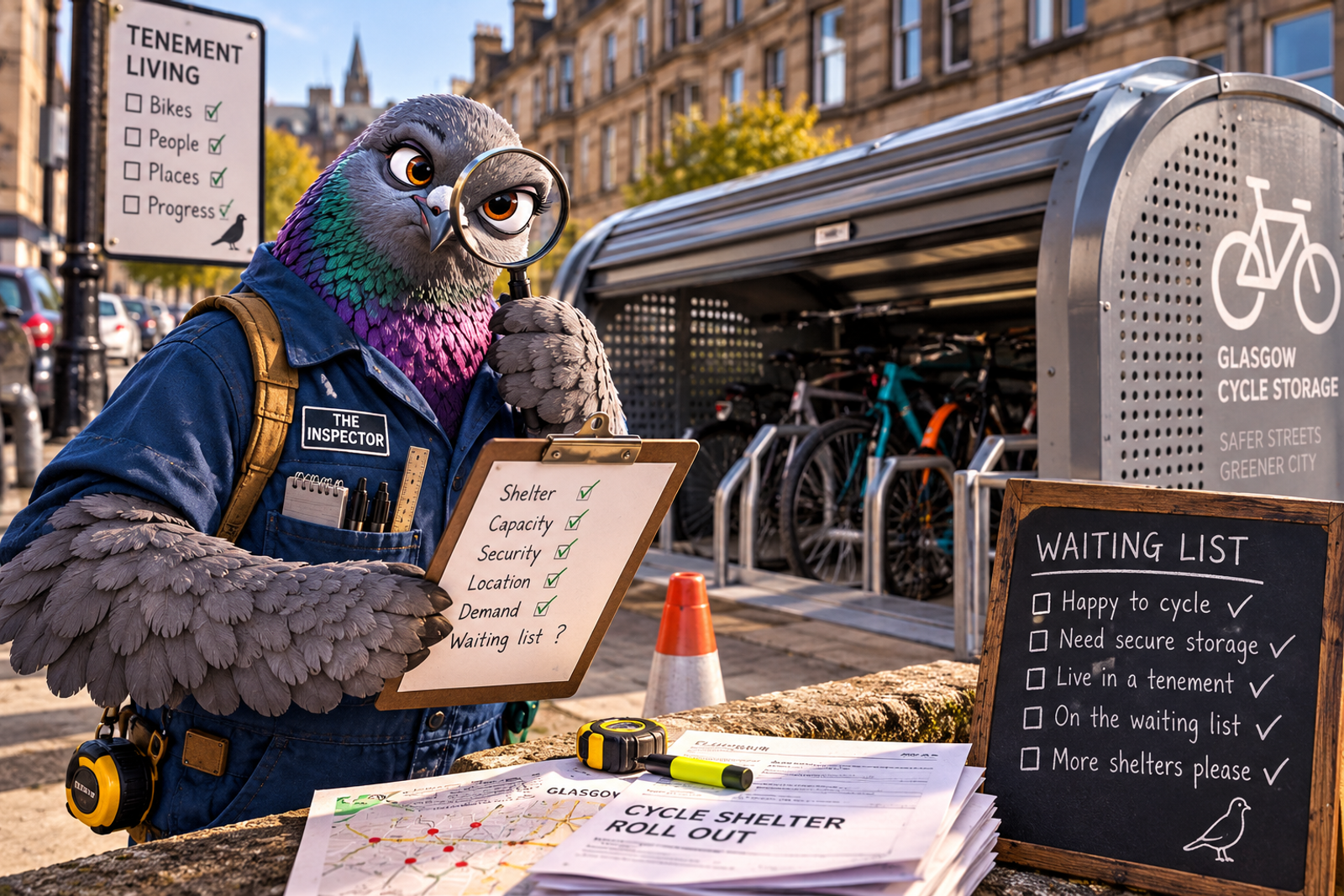



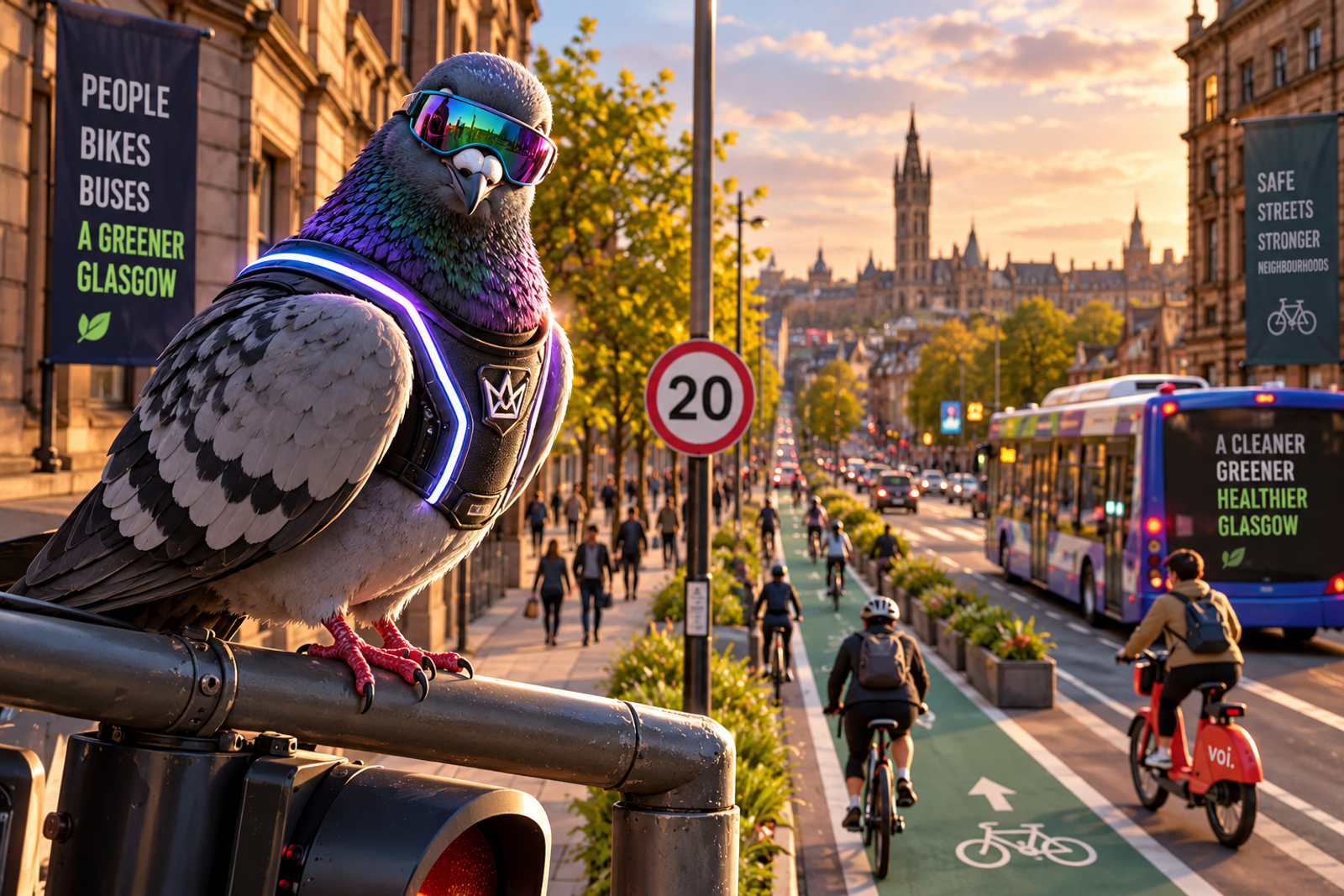
From a traffic-light arm above Great Western Road, The Upgrade has been watching Glasgow make a series of apparently unrelated decisions.
Twenty miles an hour here.
A segregated cycle lane there.
Another chunk of the Avenues finished.
Red Voi bikes multiplying across the city.
Taken one at a time, they look like projects.
Taken together, they start to look like a direction of travel.
The latest piece is speed. Glasgow is rolling out more 20mph limits across hundreds of streets, part of a much bigger move towards lower-speed urban roads.
That will annoy some drivers.
The Upgrade is less interested in the irritation than in what the city seems to be preparing for.
Scotland is putting serious money into walking, wheeling and cycling infrastructure, including Glasgow’s Avenues Plus programme. The stated ambition is to make active travel the obvious choice for more short everyday journeys.
And the machines are changing too.
Electric bikes are already normal. Shared schemes are increasingly visible. Micromobility is moving from novelty towards transport policy, while the law is still trying to catch up.
The Upgrade finds this interesting.
Because a city designed entirely around a petrol car doing 30mph looks very different from one designed around pedestrians, bikes, e-bikes, buses, EVs and whatever small electric thing somebody invents next Tuesday.
Twenty miles an hour makes more sense in that kind of city. So do protected cycle routes, wider pavements and fewer short journeys that automatically begin with somebody reaching for the car keys.
That does not mean the car disappears. The Upgrade is not imagining a future where somebody confiscates every Ford Focus at the city boundary. The more likely version is messier and much more ordinary: people use different things for different journeys. An EV for one trip, a bus for another, a bike when it makes sense, perhaps a scooter once the law catches up, and sometimes, against all available evidence about human behaviour, their own feet.
The point is not to replace one machine with another.
It is to stop designing the whole city around only one of them.
And Glasgow does seem to be edging that way.
The Avenues are changing the shape of central streets. Cycle infrastructure keeps expanding. Shared e-bikes have become part of the city furniture. Lower speed limits are spreading. EVs are no longer some distant future technology. Even the argument over e-scooters now feels less like science fiction and more like legislation waiting to happen.
None of this guarantees a better city.
Bad cycle lanes are still bad cycle lanes. A bus that does not turn up remains a bus that does not turn up. A 20mph sign on its own does not magically make a street pleasant, healthy or safe.
But infrastructure changes behaviour slowly, then all at once.
Build roads only for cars and people will mostly use cars.
Build streets that make walking, cycling, buses and small electric vehicles easier, and suddenly the calculation changes.
That is the part The Upgrade thinks Glasgow may be getting ready for.
Not a car-free city.
Not some glossy utopia of silent pods and suspiciously attractive cyclists.
Just a city where the answer to “how are you getting there?” has more than one sensible option.
There will be arguments about road space, parking, congestion and whether individual schemes actually work. There should be.
But The Upgrade suspects the interesting question is no longer whether Glasgow’s streets are changing.
They plainly are.
The question is whether, ten years from now, we will look back at the 20mph signs, the Avenues and all those red bikes and realise this was the point the city quietly started changing what a road was for.