



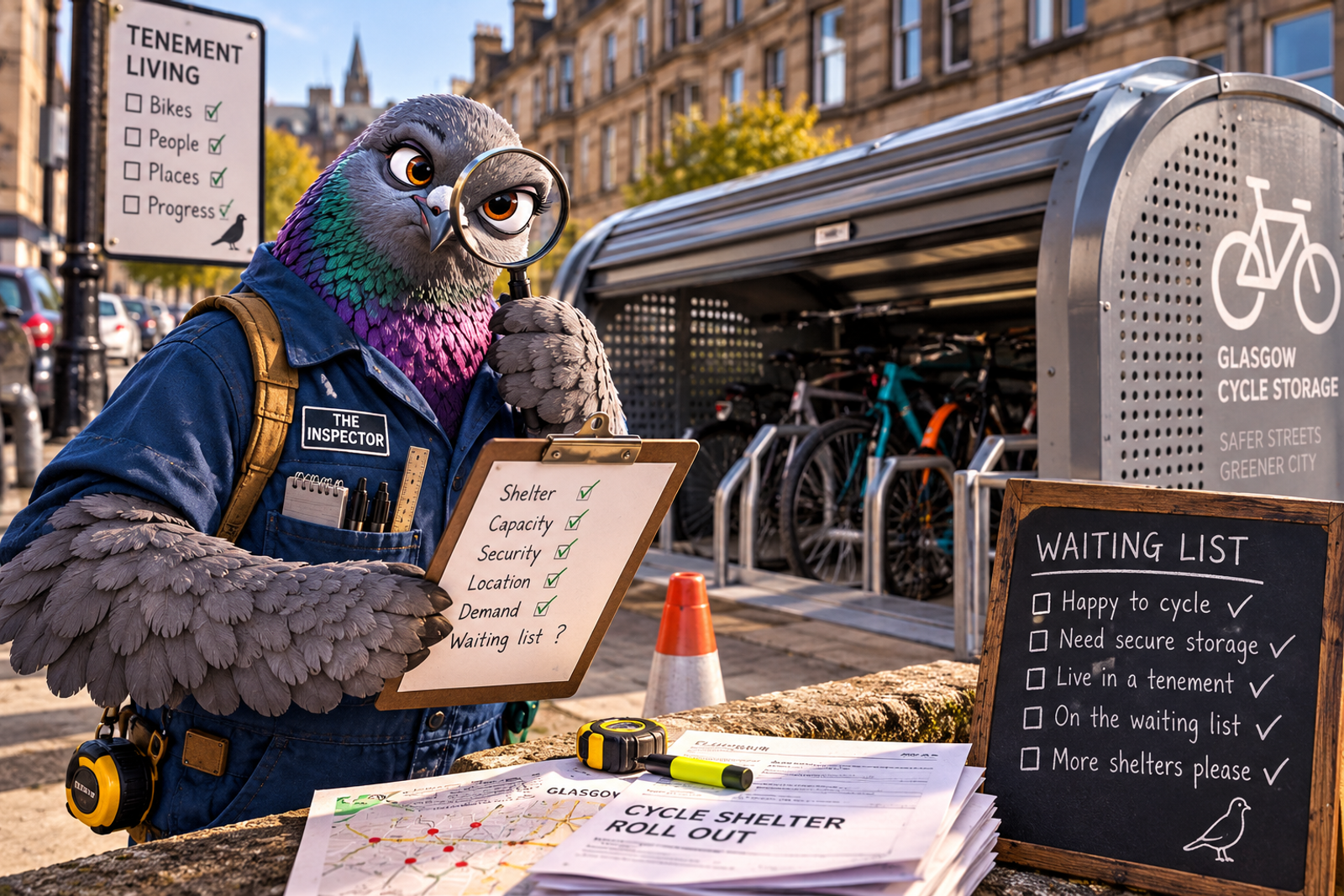
The Inspector has been examining Glasgow’s cycle shelters.
Not metaphorically.
He has counted them.
Measured them.
Checked the doors.
Looked at the waiting list.
And then looked at the waiting list again, because it appears Glasgow has managed to make secure bicycle storage popular enough to require queue management.
The shelters are those little metal pods appearing on residential streets, usually near tenements where getting a bike up three flights of stairs requires either exceptional upper-body strength or a disregard for wallpaper.
They hold six bikes.
People wanted them.
Lots of people wanted them.
The council is installing 80 more on-street secure cycle shelters. Half are already in, the rest are due by the end of November, and another 40 are planned for early 2027.
Existing occupancy is about 93%. More than 2,000 residents are on the waiting list.
The Inspector appreciates a successful scheme.
He particularly appreciates one that produces measurable evidence of success.
What interests him is the next bit.
You encourage people to cycle.
They buy bicycles.
You provide secure places to keep them.
The secure places fill up.
You build more.
Those fill up too.
Eventually somebody creates a spreadsheet with several thousand names on it.
At which point Glasgow has achieved the unusual distinction of creating pent-up demand for a metal cupboard.
None of this means the scheme has failed.
Quite the opposite.
The waiting list is evidence that people actually want the thing.
But it also creates a wonderfully simple test for the policy.
If secure storage is part of persuading people to cycle, and thousands of people are asking for secure storage, then the number worth watching is not how many shelters were announced.
It is how many people are still waiting after they are installed.
The Inspector has written that down.
Twice.
He will be checking.